I don't actually know how much someone can actually get out of our Game Pitch PowerPoint without us actually speaking over it. I will put it up to see how much understanding people can get from this. Overall though I say it's a really good PowerPoint, but that's my opinion.
Posted By Darren
0
0

 0
0
0
0
0
0
Communication Is The Key
Ascension, Event, Message, System, Technical
In a video game things can happen literally at anytime, you can have tons of things in the game that could be at any given location at any time. How would you deal with that? It can be a tough question to ask. What situations call for something( Object A ) in your game to talk to something else( Object B ) in your game? Most people, depending on your technological background would say, I would send him a message or something. In some cases that wouldn't be a bad choice, but messages aren't perfect, neither is anything else for that matter, but they do have their weaknesses. This brings me to Communication Type 1, The Postal System. For the most part people agree that the postal system is very slow or is complicated to some level.


Something You Need To Say To Someone...
In the real world the postal system consists of 3 components at the minimum, these are a sender, a deliverer and a receiver. The sender is exactly as it seems, a person who has a MESSAGE that he/she wants to convey to another. In the game world this would parallel exactly as it seems. The Deliverer is effectively the postal service, where the messages are processed ad delivered. In itself the Postal service isn't a one man job, because it consists of multiple roles. The roles can be broken down as such, mail is received from the sender, taken to the Post Office to be processed, and after processing it must be delivered. As you can already see this model is starting to take up a lot of time. In the game world this is almost paralleled, mostly because of the steps. At a high level it is the same but doing it is different, first because the sender must know exactly who the message should be sent to so that the post office can send it to the proper destination, at the same time the post office must know who that is so they can sort it internally. Finally the receiver part comes after the message was sent, processed, and is now to be delivered. Hopefully the Post Office knows who the receiver is and is able to get it there as soon as possible. If every thing has gone according to plan, everything should be fine and dandy with a letter in the receiver's mailbox in as timely a manner as possible. In general the postal system is very useful, but time and other varying factors take it down.

What If I Just Don't Care...
Communication Type 2 is more along the lines of TV, more precisely the news most times. This system is called the EVENT system, where there are a lot of traits from the message system, but a lot of the focus is shifted to be more time efficient. In general the TV world works like the postal system in terms of having three steps and a goal. In the TV/News model weight is shifted from the Sender/Middle Man step to the Middle Man/Receiver step. In the real world, an episode is created sent to some sort of communicator ( usually a antenna or something similar) and is sent out to anyone who cares enough to subscribe, not unlike the magazine system. For the most part this saves time because everyone that exists doesn't have to be searched through to find a specific person. At the same time there is the slight downside that anyone who cares has to make the effort to sign up to receive each and every event that they want to know when it happens. At the same time the helps the both sides, the sender only makes events happen when there is someone who wants it, the middle man only has to deliver to any people that have subscribed to this specific event when it happens, and the subscriber/receiver only gets stuff he/she cares about.

Custom Models Are Cool Too...
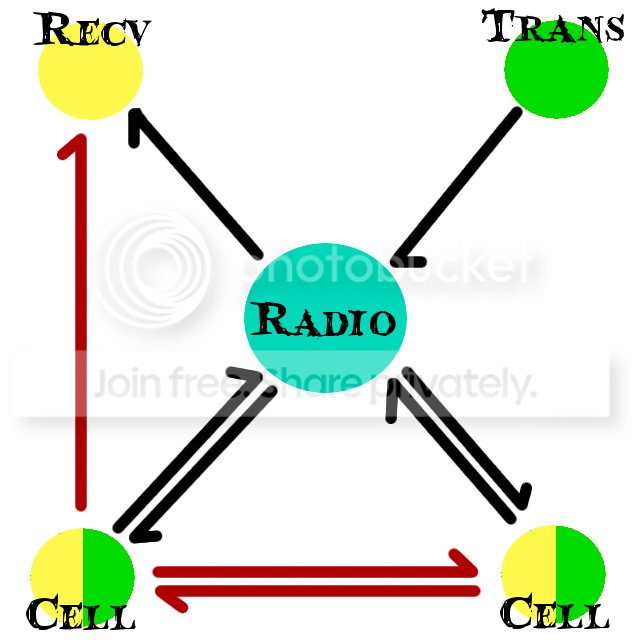
I'm sure there are other models, but these are the to that are most commonly used. For this game, Ascension, I have designed a special model that has the best of both without being either. This model is based off of RADIO Communication, which if it had to be typed it would be Communication Type 2.5. The Radio model is very similar to the TV model, but with an extra layer, that I call the Cellular/Communicator layer. In general the radio communication layer splits up attributes to be efficient, in the model there are two base types, the transmitter and the receiver. All the transmitter can do is send, and all the receiver can do is receive. In a game world there are items that don't always need both, then there are some that need to do both. This is where the cellular layer comes in, essentially playing the role of a cell phone. A cell phone can do both of these functions, very well usually. The cellular layer takes( inherits ) everything from both the transmitter and the receiver and adds to it. Anyone using this model that has a cell phone can send events to people who subscribe to the events, but at the same time can communicate using a contact list.A contact list is essentially a phonebook in a real cell phone. You have the ability to have anyone that is part of the cellular layer or is a receiver can give you their unique ID and you can literally send events directly to them as if it was a message system.

In The End...
I'm sure there are many other ways to implement communication between game object, but Type 1 and 2 seem to be very popular, and type 2.5 seems like it's a good idea. In all there are so many creative communication models that can be used to create different ways to communicate in a video game, but it all depends on what you need in the end.
Posted By Darren
Ascension Over View
Wednesday, June 17, 2009 Ascension, Design, Story
In Ascension, the player will have control of the main character Yahrek, a young man who upon returning to his village from a long journey has discovered that his town has been destroyed by an evil triclops. Yahrek must fight enemies and explore the world in order to gain levels, building stats to defeat the tricolps and return the legendary weapon, Heritage, which was stolen by the monster.
Upon starting the game the player is introduced to the only other survivor of the village, Edom. Edom is the towns vendor who was out gathering herbs in the marshlands, as he is one of the finest alchemist in the land, at the time of the attack. Edom will explain to Yahrek that the library to the north has burned down as well and suggest that he should investigate the site, as well as other points of interests in the world. Edom has also agreed to supply Yahrek with different potions, for a price.
As Yahrek explores the world he will face different opponents such as goblins, thieves, and the undead. Through hack and slash melee combat, Yahrek must over come these enemies in order to gain enough experience to gain levels. Once enough enemies are defeated to gain a level the player gains two skill points to spend in the different stat trees, these being Strength, Agility, and Defense. Putting skill points into the Strength stat will increase the damage done to enemies as well as give a special attack and critical hit bonus. The Agility stat will increase the critical hit chance, increase attack speed, and give a sprint ability. Defense will grant Yahrek with more total hit points, a passive parry ability, and thorn skin where an attacking enemy will take damage when the deal damage.
Once the player feels they possess enough skill they may seek out the tricolps for the final battle.
When the tirclops is defeated Yahrek regains Heritage for a safe return to the village. At this point the player will have an option to start a New Game+ where Yahrek yields Heritage, and can try timed runs of the game with the more powerful weapon and all their stats from previous games.
Ascension will be an amazing game with many possible permutations depending on play style and how skill points are spent. Please feel free to leave a comment if you have any questions.
Upon starting the game the player is introduced to the only other survivor of the village, Edom. Edom is the towns vendor who was out gathering herbs in the marshlands, as he is one of the finest alchemist in the land, at the time of the attack. Edom will explain to Yahrek that the library to the north has burned down as well and suggest that he should investigate the site, as well as other points of interests in the world. Edom has also agreed to supply Yahrek with different potions, for a price.
As Yahrek explores the world he will face different opponents such as goblins, thieves, and the undead. Through hack and slash melee combat, Yahrek must over come these enemies in order to gain enough experience to gain levels. Once enough enemies are defeated to gain a level the player gains two skill points to spend in the different stat trees, these being Strength, Agility, and Defense. Putting skill points into the Strength stat will increase the damage done to enemies as well as give a special attack and critical hit bonus. The Agility stat will increase the critical hit chance, increase attack speed, and give a sprint ability. Defense will grant Yahrek with more total hit points, a passive parry ability, and thorn skin where an attacking enemy will take damage when the deal damage.
Once the player feels they possess enough skill they may seek out the tricolps for the final battle.
When the tirclops is defeated Yahrek regains Heritage for a safe return to the village. At this point the player will have an option to start a New Game+ where Yahrek yields Heritage, and can try timed runs of the game with the more powerful weapon and all their stats from previous games.
Ascension will be an amazing game with many possible permutations depending on play style and how skill points are spent. Please feel free to leave a comment if you have any questions.
Posted By Bryan
Sound And The Player Experience (Feel The Music XY/XX)
Friday, June 12, 2009 Design, DS, Fable, Feel The Magic: XY/XX, Genji, Music, Sound, Theory
Learning From Examples:
How do I make the player feel engaged in the music? How do I design good enough sounds so the player doesn't want to mute the music? How do I make the user 'feel' how I want them to feel? In general those seem to be the questions that I'm currently thinking about. Most of the time these are very difficult questions to answer, especially when you're limited in both time and experience. At this point the best that I'm able to do is reference other games that are similar to 'Ascension' and develop a general strategy so that i can get a general feel for how atmosphere should be implemented.
Battle Sounds/Music:
Most action adventure games have some type of themed sounds/music to make the player feel involved. While the player is not dying or in danger of dying an average game would play music that is slightly upbeat, but not with a high tempo so the player feels like he/she actually is in danger. Why does that matter, music is music? Actually that's not always true. In general music cannot be interchanged in most situations, most music is designed to fit in a specific place in a game. Next time you play a game, preferably an adventure or an RPG, try either muting the volume or listening to music.
I'm sure you as the player will feel detached from the experience, you might even lose interest in the game at some points. Granted some genres don't have that problem nearly as much as the more story heavy or action heavy games, for example racing games. Racing games don't have this problem nearly as much as other genres, because there is no one sound or feeling attached to the driving experience. There also is personal preference, as some people might like to hear the sound of their engine or others who like to listen to their favorite music.
Read Below the video before watching it.
Fable 2 (Xbox 360):
Listen to this video first without the sound. After you finish it think about the depth, how you feel versus how you think you should feel. Then watch it again with sound, and see if you felt the same way as before. Granted, it's not the same if you have played the game before, because you would be expecting it or know what the general feel of the game is.
Example of a good player environment:
Genji: Days Of The Blade (PS3)
How do I make the player feel engaged in the music? How do I design good enough sounds so the player doesn't want to mute the music? How do I make the user 'feel' how I want them to feel? In general those seem to be the questions that I'm currently thinking about. Most of the time these are very difficult questions to answer, especially when you're limited in both time and experience. At this point the best that I'm able to do is reference other games that are similar to 'Ascension' and develop a general strategy so that i can get a general feel for how atmosphere should be implemented.
Battle Sounds/Music:
Most action adventure games have some type of themed sounds/music to make the player feel involved. While the player is not dying or in danger of dying an average game would play music that is slightly upbeat, but not with a high tempo so the player feels like he/she actually is in danger. Why does that matter, music is music? Actually that's not always true. In general music cannot be interchanged in most situations, most music is designed to fit in a specific place in a game. Next time you play a game, preferably an adventure or an RPG, try either muting the volume or listening to music.
I'm sure you as the player will feel detached from the experience, you might even lose interest in the game at some points. Granted some genres don't have that problem nearly as much as the more story heavy or action heavy games, for example racing games. Racing games don't have this problem nearly as much as other genres, because there is no one sound or feeling attached to the driving experience. There also is personal preference, as some people might like to hear the sound of their engine or others who like to listen to their favorite music.
Read Below the video before watching it.
Fable 2 (Xbox 360):
Listen to this video first without the sound. After you finish it think about the depth, how you feel versus how you think you should feel. Then watch it again with sound, and see if you felt the same way as before. Granted, it's not the same if you have played the game before, because you would be expecting it or know what the general feel of the game is.
Example of a good player environment:
Genji: Days Of The Blade (PS3)
As you watch the video of Genji, take note of the music, the sounds the players character makes and the sounds of the enemies. For the most part, thorough the game and this video, you will notice that both the visuals and the audio are themed towards the theme of Feudal Japan.
Next Time:
Sound And The Player Experience Pt.2 (Ninety-Nine Themes)
Posted By Darren
BrainStorm 101
Wednesday, June 10, 2009 101, BrainStorm
Aww Yeah, BrainStorm!
BrainStorm is starting a blog? Cool.
Time for some quick Q&A. ( Real questions That Were Asked )
Q: Why BrainStorm?
A: It's cool. Plus it sounds kinda smart.
Q: What's this for?
A: Final project. Its for a 5 month long class that has us essentially plan and create a game.
Q: Us?
A: Yeah. My group.
Jonathan Blackey, Andrew Corren, Chris Scribner, Bryan Seabury, Timothy Trott, and myself Darren Palmer.
Q: Cool, So what are you doing?
A: An Fantasy Action/Adventure Game w/ RPG Elements, more details coming soon.
Q: Is there a name?
A: Yeah, the name is 'Ascension', cool right. Thank Andrew for that.
BrainStorm is starting a blog? Cool.
Time for some quick Q&A. ( Real questions That Were Asked )
Q: Why BrainStorm?
A: It's cool. Plus it sounds kinda smart.
Q: What's this for?
A: Final project. Its for a 5 month long class that has us essentially plan and create a game.
Q: Us?
A: Yeah. My group.
Jonathan Blackey, Andrew Corren, Chris Scribner, Bryan Seabury, Timothy Trott, and myself Darren Palmer.
Q: Cool, So what are you doing?
A: An Fantasy Action/Adventure Game w/ RPG Elements, more details coming soon.
Q: Is there a name?
A: Yeah, the name is 'Ascension', cool right. Thank Andrew for that.
Posted By Darren
Subscribe to:
Posts (Atom)